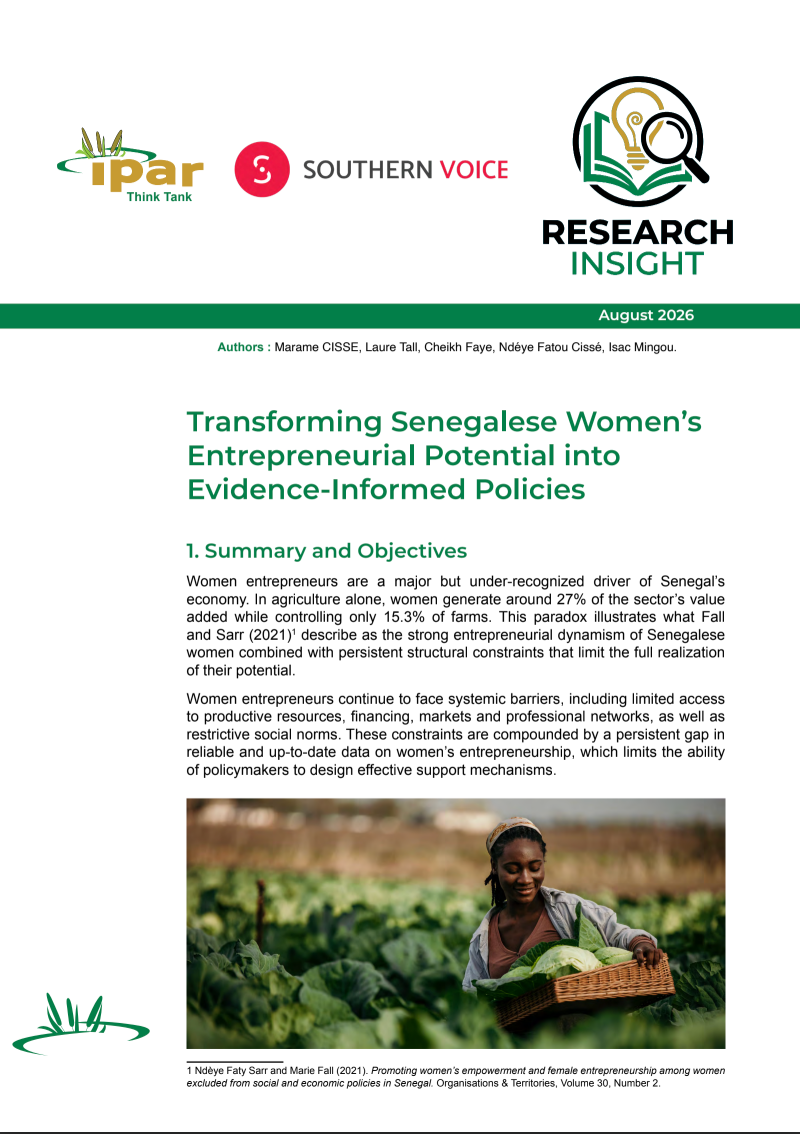
Women entrepreneurs are a major but under-recognized driver of Senegal’s economy. In agriculture alone, women generate around 27% of the sector’s value added while controlling only 15.3% of farms. This paradox illustrates what Fall and Sarr (2021)1 describe as the strong entrepreneurial dynamism of Senegalese
women combined with persistent structural constraints that limit the full realization of their potential.
Women entrepreneurs continue to face systemic barriers, including limited access to productive resources, financing, markets and professional networks, as well as restrictive social norms. These constraints are compounded by a persistent gap in reliable and up-to-date data on women’s entrepreneurship, which limits the ability of policymakers to design effective support mechanisms.
At a time when Senegal is revising key economic and social policy frameworks, strengthening the
availability and use of gender-sensitive evidence has become increasingly important. This project
responds to that need by synthesizing existing data, generating new evidence and creating spaces
for dialogue between researchers, policymakers and actors of the entrepreneurial ecosystem.
The objective of the project is not only to document gender gaps in entrepreneurship, but also
to strengthen the use of evidence in policymaking. Through a participatory research process and
joint interpretation of the findings with public institutions, the initiative seeks to transform statistical
information into actionable insights that can inform policies supporting women’s and youth
entrepreneurship.